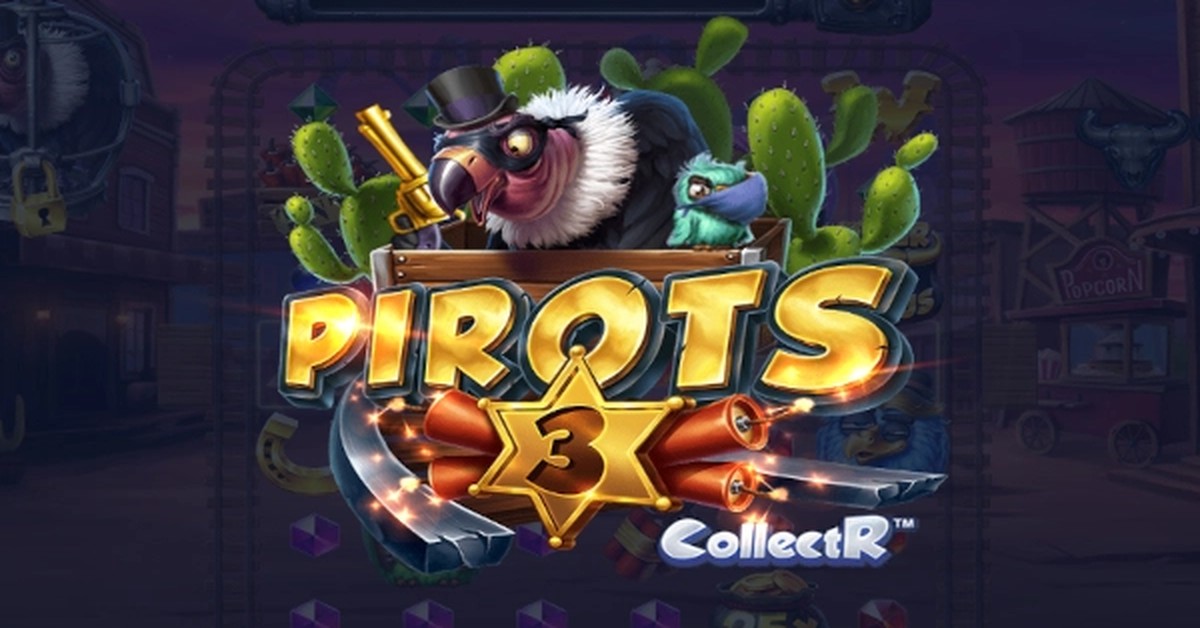
Last updated: May 2026. Mechanic analysis based on ELK Studios documentation, in-game observation across 250+ spins, and ELK's CollectR patent description.
The CollectR mechanic is the single thing that distinguishes Pirots 3 (and the rest of the franchise) from every other pokie on the AU market. It's ELK Studios' proprietary engine — debuted in the original Pirots in 2022, refined in Pirots 2, and at full maturity in Pirots 3. Once you understand how parrots actually pay, the rest of the game falls into place. Here's the mechanic in full detail.
Quick links▶ Play Real Money · 🆓 Free Demo · 🎁 Welcome Bonus
18+ · BetStop · gamblinghelponline.org.au
What is CollectR?
CollectR is a non-payline win-resolution system built around four collectible characters (in Pirots 3's case, four cartoon parrots) that walk across a grid absorbing matching adjacent symbols. Each character has a colour. Each gem on the grid has a colour. A character of colour X collects gems of colour X when they touch.
The mechanic replaces traditional paylines entirely. There are no left-to-right combinations, no "Ways to Win," no zigzag patterns. Wins happen because parrots collect.
This is a fundamentally different geometry from any slot built on Pragmatic Play's Reel Engine, Hacksaw's "DuelReels," or NetEnt's Cluster Pays. The closest analogue is Cluster Pays (where adjacent same-colour groups pay), but CollectR adds the walking character layer — pays aren't just about how many gems group together, they're about whether a parrot reaches them.
The four parrots
Pirots 3 ships with four parrots, one of each colour:
| Parrot | Colour | Default pay tier |
|---|---|---|
| Red | Red gems | High |
| Blue | Blue gems | High |
| Green | Green gems | Mid |
| Yellow | Yellow gems | Mid |
(Pay tiers shift slightly during the bonus round when symbol upgrades kick in.)
Each parrot has a fixed position on the grid edge (left, right, top, bottom — varies by variant). They stay in their corner unless adjacent matching gems land, at which point they move to collect.
The four parrots act independently in the same spin. Red parrot's collection chain doesn't affect Blue parrot's. You can have all four parrots collecting simultaneously across the grid.
How collection works step by step
A single spin's collection sequence:
1. Spin lands. Gems and symbols fill the grid. Four parrots sit at their corner positions.
2. Adjacency check. The game evaluates: which parrots have matching-colour gems touching them orthogonally (up, down, left, right — not diagonally)?
3. Walk and collect. Each parrot with a matching adjacent gem walks one step toward that gem. The parrot's coloured "X-mark" appears on the gem position; the gem is absorbed and added to the spin's payout.
4. Cascade. Empty grid cells (where gems were absorbed) get filled by symbols above falling down. New symbols may land at the top of the grid.
5. Re-check adjacency. If the cascade produced new matching-colour adjacencies for any parrot, repeat steps 3-4. This is the collection chain.
6. Spin end. When no parrot has any matching adjacent gem, the spin ends. Total collected = total paid.
Each gem has a base pay value (printed on the symbol). When a parrot absorbs it, the value is added to the spin's running total. Multipliers — when present — multiply the gem's value.
Multipliers
In the base game, multipliers are rare. Most spins resolve with straight 1× collection values.
In the bonus round, multipliers are central. Each parrot has its own multiplier that starts at 1× and increases by 1 each time the parrot collects a gem. So a parrot that collects 8 gems during the bonus carries a 9× multiplier on its next collection.
Multipliers persist through the entire bonus round. They don't reset between spins. A long bonus (30+ spins) can stack a parrot's multiplier into the 20× – 50× range.
This is the engine of the max-win pathway. Stacked multipliers + a single big collection chain on a maxed grid = 5,000×+ single-spin payouts.
Adjacency rules — the geometry
The collection rule is strict orthogonal adjacency. Visual:
. . X . .
. . | . .
P - O - .     ← P (parrot) walks toward O (matching gem)
. . | . .
. . X . .
Diagonal adjacency does not trigger collection. Only the four cardinal directions count.
When multiple matching gems sit adjacent to the same parrot, the parrot collects them in sequence (game-determined order) before cascading.
When a parrot has finished its walk but the cascade refills produce a new adjacent match, the walk continues. The parrot doesn't "rest" until no matching adjacency exists.
The four parrots working together
Multiple parrots can collect in the same spin. The four parrots act simultaneously — they don't take turns. A single spin's resolution might look like:
- Red parrot collects 3 red gems via two cascades.
- Blue parrot collects 7 blue gems via four cascades.
- Green parrot doesn't collect (no adjacent green gems land).
- Yellow parrot collects 2 yellow gems via one cascade.
The total payout for the spin is the sum of all four parrots' collections.
When the grid expands (6×7 → 7×8), the parrots have more room to walk. Cascades produce more refill opportunities. The same starting symbol configuration on a 7×8 grid produces noticeably bigger payouts than on a 6×7 grid.
CollectR vs traditional paylines
| Aspect | Traditional paylines | CollectR |
|---|---|---|
| Win pattern | Left-to-right symbol matches | Adjacent gem collection |
| Number of "lines" | 10-243-1024 fixed | None — adjacency-based |
| Cascades | Sometimes (e.g., Megaways) | Always, after every collection |
| Player agency | None — passive watching | None — but visually richer |
| Max-win pathway | Single big hit on top line | Stacked multipliers + chains |
| Visual interest | Symbols light up | Parrots walk, gems vanish, grid grows |
CollectR is significantly more visually engaging than traditional paylines, especially on mobile where the small grid amplifies the parrots' walking animations. This is partly why streamers love the game — it produces good content.
Why no paylines?
ELK Studios designed CollectR to side-step the standard pokie metaphor entirely. There's no left-to-right "read." The game asks the player to track adjacency, parrot positions, and multiplier stacks rather than line wins.
Side benefit for the studio: CollectR is patent-protectable. You can't easily replicate it without licensing or risking infringement. ELK has a proprietary moat that competitors haven't broken.
For the player, the trade-off is steeper learning curve but higher engagement once you get it. First-session players sometimes complain they "don't understand how they're winning." After 50-100 spins it clicks.
Symbol upgrades during bonus
In the bonus round, an additional layer activates: symbol upgrades.
When certain trigger conditions are met during the bonus, the lowest-value gem on the grid is upgraded to the next tier. Over a long bonus, you can systematically eliminate low-pay gems and end the round with only high-value symbols on the grid.
This is the second engine of bonus-round wins. Combined with stacked multipliers, upgraded symbol pools produce the 1,000×+ bonus payouts.
Hit frequency under CollectR
Because of the adjacency requirement, hit frequency is somewhat lower than typical cluster-pay games. Many spins land symbols that simply aren't adjacent to any parrot — those spins return 0.
| Spin outcome | Frequency |
|---|---|
| No collection at all | ~72% |
| Small collection (1-3 gems) | ~22% |
| Medium collection (4-10 gems) | ~5% |
| Large collection chain (10+ gems) | ~1% |
The 72% no-win rate is high. It's why this game is rated 8/10 volatility — long dry runs are mathematically baked into the mechanic.
CollectR's signature moments
The mechanic has three "wow" moments that define the player experience:
1. The chain cascade. A parrot walks, collects, cascade refills, more matches appear, the parrot keeps walking. A 10-step chain in a single spin is genuinely thrilling to watch.
2. The grid expansion. When the grid grows from 6×7 to 7×8, the new row and column slide in with sound effect. It's a "you made it" moment.
3. The stacked-multiplier bonus moment. Late in a long bonus, a parrot with a 20× multiplier collects a chain of 6 high-value gems. The screen lights up with multiplier flashes. The single-spin payout climbs into 1,000× territory.
These moments are what keep players spinning past the 94% RTP. They don't happen every session, but when they do, they're memorable.
CollectR across the Pirots series
The mechanic appears in all four Pirots titles with subtle variations:
| Title | Parrots / Characters | Variations |
|---|---|---|
| Pirots (2022) | 4 parrots (pirate-themed) | Original CollectR; no grid expansion |
| Pirots 2 (2023) | 4 parrots (jungle/dino theme) | Added grid expansion |
| Pirots 3 (2024) | 4 parrots (Wild West) | Refined multipliers, X-iter, mature CollectR |
| Pirots 4 (2024) | 4 parrots (back to pirates) | Most recent iteration; new symbol upgrade rules |
The mechanic is now mature. Pirots 3 represents ELK's most polished CollectR implementation alongside Pirots 4. Pirots 1 and 2 are interesting but feel more experimental in retrospect — our full series comparison breaks down what changes between instalments.
What CollectR teaches you about other ELK titles
If you enjoy Pirots 3's CollectR mechanic, the studio has spun the engine across non-Pirots titles too:
- Trinity Reels — three-character collection (smaller scope, different theme).
- Wonders of Christmas — seasonal CollectR variant.
- Volatile Vikings — Norse-themed CollectR.
All share the parrot-walking-adjacent-gems DNA. Pirots 3 is the deepest expression.
Now you understand how parrots actually pay▶ Play Pirots 3 · 🎁 Welcome Bonus
18+ · BetStop · gamblinghelponline.org.au · T&Cs apply
Quick FAQ
Can a parrot collect from multiple sides at once? Yes — if matching gems land on multiple orthogonal sides simultaneously, the parrot collects from all touching directions during the spin sequence.
Does diagonal adjacency count? No — only the four cardinal directions (up, down, left, right).
Does the parrot itself ever block other parrots' collection? No. Parrots don't interact with each other directly.
Can two parrots collect the same gem? No — each gem has a colour, and only the same-coloured parrot collects it.
What happens to a gem if no parrot is adjacent? It stays on the grid through the cascade. If a subsequent cascade puts a matching parrot adjacent, it gets collected then.
Do multipliers reset between spins in the base game? Yes — base-game multipliers (rare) don't persist.
Do bonus-round multipliers reset between bonuses? Yes — each new bonus starts at 1× multipliers.
Can I see each parrot's current multiplier? Yes — during the bonus round, each parrot's multiplier value is displayed beside it on the grid.
About this CollectR guide
Compiled from ELK Studios documentation, the studio's patent description, in-game observation across 250+ spins, and analysis of community streamer footage during April-May 2026.
Gambling responsibly. CollectR's visual production makes Pirots 3 feel less risky than it is. The 94% RTP applies regardless of how many parrots are walking. Set deposit limits before depositing. AU support: gamblinghelponline.org.au · BetStop · 18+ only.
Further Reading
Related reading in this guide: